design notes
Prompts are design decisions
We wrote a playbook of twenty prompts. The important part is the five things we agreed AI does not touch.
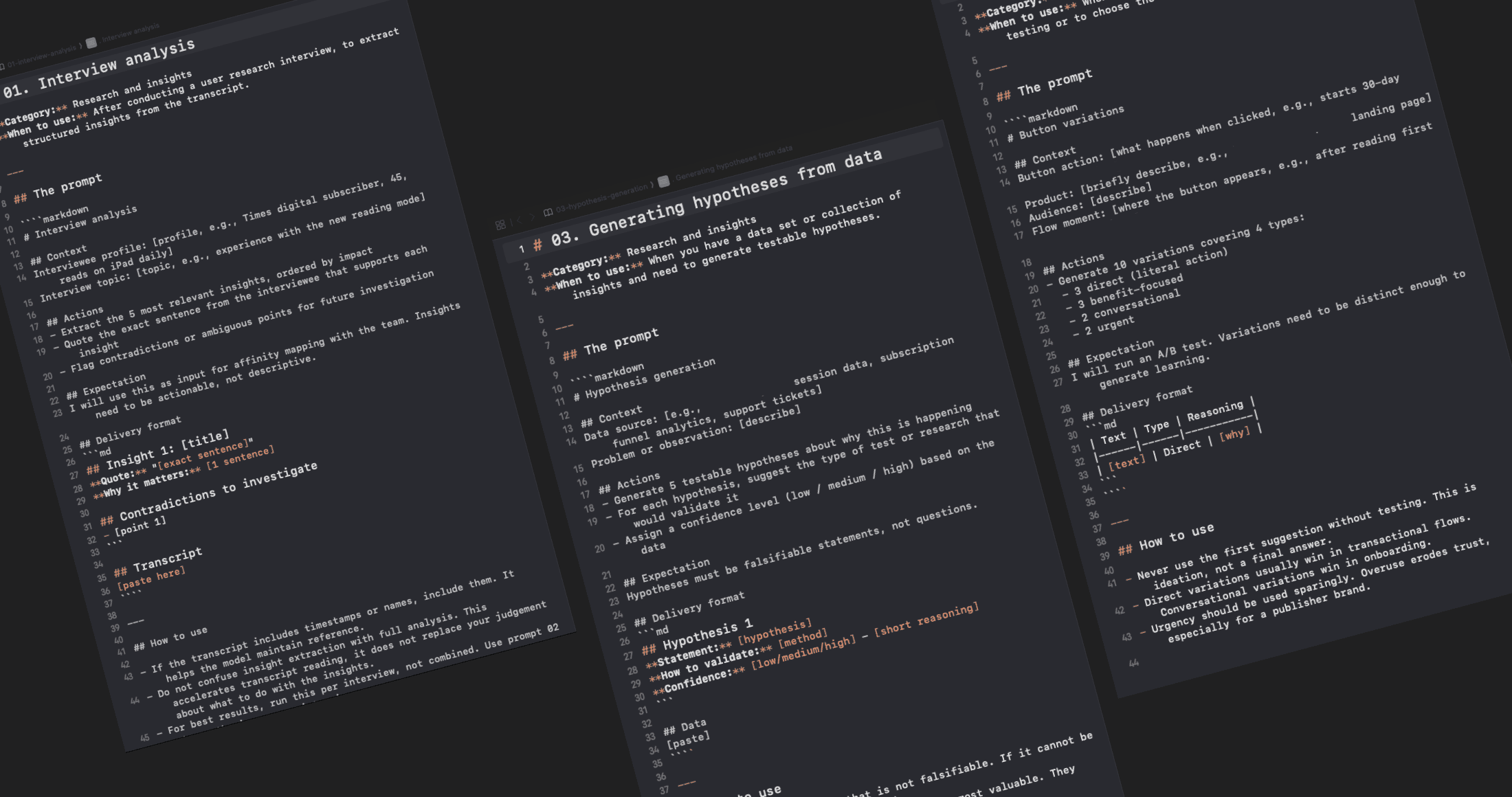
There is a document in our design handbook called the Prompt Playbook. Twenty prompts the team uses for real work: research synthesis, first-draft documentation, exploring layout directions, interrogating a brief before we accept it.
People ask about the twenty. The part that matters is the other list, the five exclusions. The things we agreed AI does not get to touch.
The reasoning is simple. AI makes it very easy to produce more output, and output is not value. Without a rule, the volume goes up, everyone feels productive, and quality quietly goes sideways. Faster mediocre work is still mediocre work. It just arrives sooner and there is more of it.
So the playbook is not really a productivity document. It is a quality document that happens to make people faster. Every prompt in it exists because we tested it against a question: does this compound, or does it merely accelerate? Prototyping compounds, because a designer who tests four directions in the time one used to take is learning four times faster. Documentation compounds, because written-down decisions outlive the person who made them. Generating final design work does not compound. It just fills the review queue.
We also measure what we ship, not what we generate. That single choice removes most of the fake productivity that AI tools create, because nobody gets credit for volume.
A prompt is a design decision. It encodes what you think good looks like, what you are willing to delegate, and what you are not. Teams that write them carefully get a sharper version of themselves. Teams that do not get a faster version of their own worst habits.